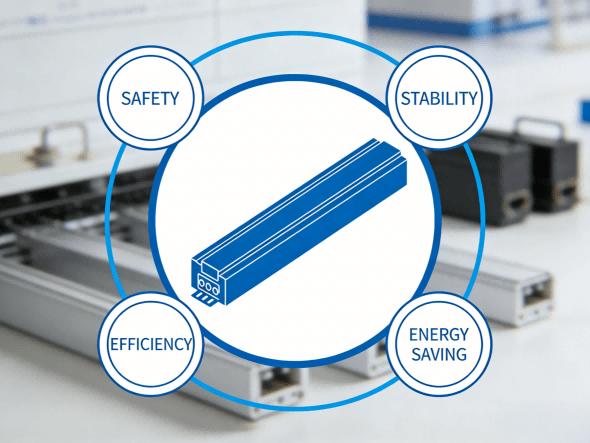

Choosing a suitable busbar trunking system is not just about looking at product specifications; it also requires making decisions based on the actual needs of the project.
1. Current capacity
For commercial buildings such as office buildings and shopping malls, the load mainly comes from lighting, air conditioning, and elevators, while factories require more current due to large machinery and continuous production equipment. Insufficient capacity can easily lead to overheating, unstable operation, and even safety risks; excessive capacity may add unnecessary costs.
2. Installation environment
When selecting busbar trunking, external environmental conditions such as temperature, humidity, dust concentration, and moisture exposure must be considered. When installed indoors in a controllable environment, a standard protection rating is sufficient; but for industrial plants, warehouses, or outdoor locations, products with higher protection ratings should be chosen to guard against dust, water, and mechanical impact.
3. Layout and routing requirements
Building height, the distance between the power source and the load, and the amount of installation space all affect the routing and layout of the busbar trunking. High‑rise buildings generally use vertical routing to deliver power floor by floor; industrial workshops mostly use horizontal routing to conveniently supply power to production lines and equipment.
4. Planning for future expansion
Buildings may add new equipment, expand production capacity, or increase operating loads. Choosing a busbar trunking system that allows for additional tap‑off points and easy capacity expansion saves both time and cost.
5. Safety and reliability
The busbar trunking system should provide stable electrical performance and minimize the risk of failure. Insulation quality, the tightness of joints, and the reliability of connections directly affect whether short circuits, overheating, or power outages occur.
6. Ease of maintenance
If the installation location is reasonable and the connection points are well designed, maintenance personnel can quickly perform routine inspections and troubleshooting without prolonged downtime.
FAQs
1. How do I decide the right current capacity for my project?
It depends on your real load, such as HVAC, lighting, or heavy machinery. In most cases, Wondon helps clients match capacity with actual operating conditions to avoid overload or wasted investment.
2. How much does the installation environment affect the selection?
It directly determines the required protection level of the system. For example, in dusty or humid sites, Wondon usually recommends higher IP-rated solutions for safer long-term operation.
3. How should I think about layout and routing before choosing a system?
It depends on building height, distance, and available installation space. Wondon typically checks your site layout first to confirm whether vertical or horizontal routing fits better.
4. Can the system handle future expansion if my load increases?
Yes, if the system is designed with expansion space and tap-off points. From Wondon’s experience, planning expansion early avoids costly redesigns later.
5. What is most critical for safety and reliability in daily use?
Connection quality, insulation, and joint stability. Wondon often finds that most long-term issues come from weak connections rather than the busbar itself.