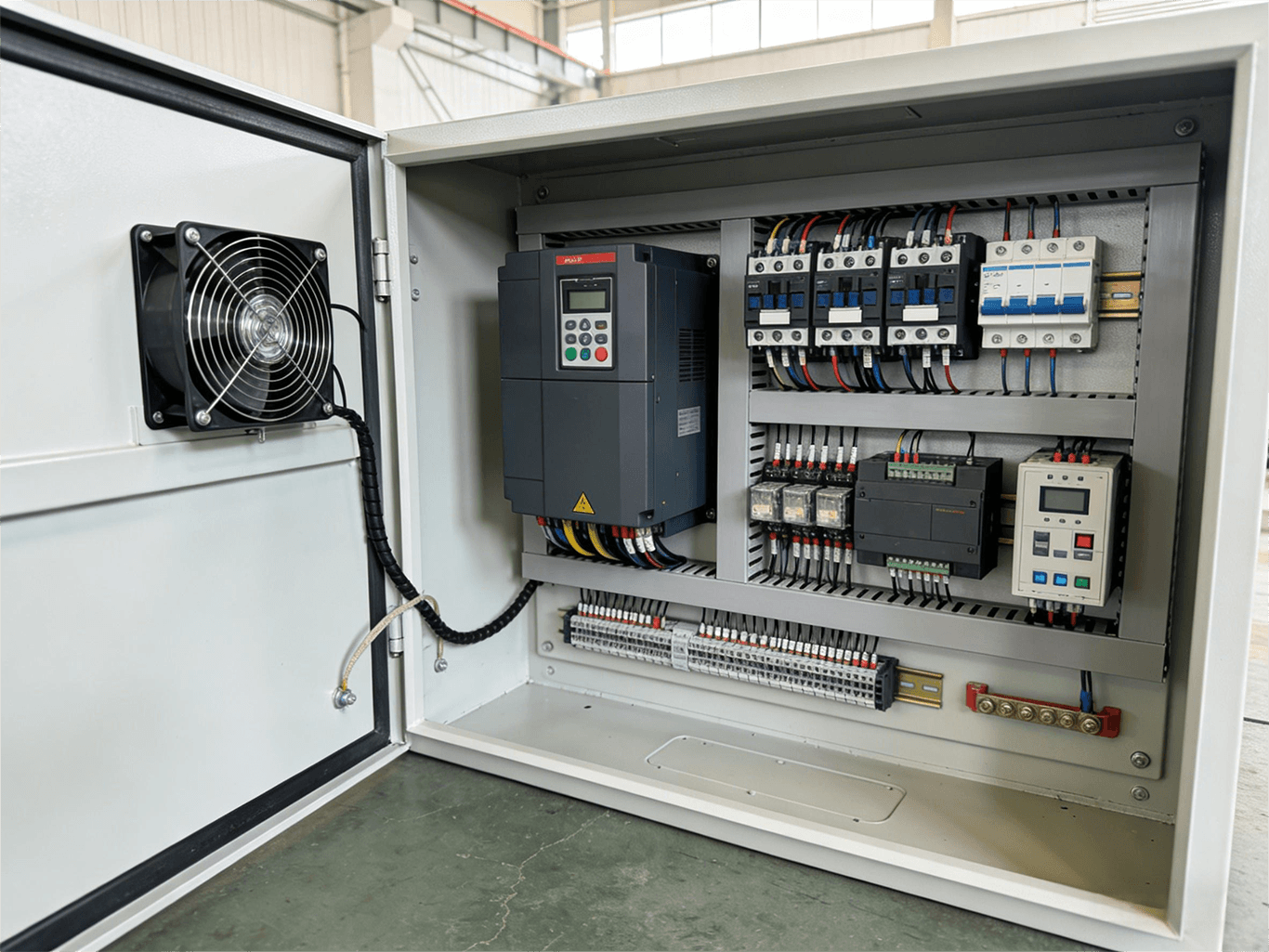

The main circuit of the soft starter control panel is typically composed of three pairs of anti‑parallel thyristors in the three‑phase circuit, connected in series with the motor stator circuit. By adjusting the thyristor’s firing delay angle (i.e., the conduction angle), the system controls how long the voltage conducts in each AC half‑cycle, thereby continuously adjusting the output voltage. This allows the motor to start from a lower voltage and gradually increase voltage, rather than starting at full voltage all at once.
During the starting process, the controller monitors the motor’s operating status in real time, typically by sampling the current signal, and some systems also estimate the motor speed based on operating conditions. The system compares this real‑time data with an internally preset starting curve (such as a voltage ramp curve or current limit curve). Once a deviation between the actual operation and the set target is detected, the controller automatically adjusts the firing angle of the thyristors, and the output voltage changes accordingly.
This dynamic adjustment is a closed‑loop control system. The soft starter control panel ensures that the motor starts smoothly according to preset parameters, reducing starting current and mechanical stress, and improving the stability and reliability of the entire system.
FAQs
1. If you’re wondering how a motor starts smoothly instead of suddenly, how does a soft starter control panel achieve that?
It controls voltage using thyristors, gradually increasing power instead of applying full voltage at once. Wondon designs this process so your motor starts smoothly and safely without harsh impact.
2. Inside your project, what is actually happening while the motor is starting?
The panel continuously reads motor current in real time and adjusts output step by step. Wondon systems keep this adjustment automatic so the motor always follows a stable starting curve.
3. How does the system “decide” when to increase or reduce voltage during startup?
It compares real operating data with a preset starting curve and corrects the output instantly if there is a deviation. Wondon uses this closed-loop control to keep the startup predictable and stable.
4. From a practical point of view, what difference will I feel compared to direct starting?
You will see fewer voltage drops, less mechanical vibration, and smoother equipment response. Wondon soft starter solutions help your system feel more stable from the first second of operation.
5. If my project conditions are not standard, can the startup behavior be adjusted?
Yes. Wondon can fine-tune current limits, ramp time, and control logic based on your motor and working environment, so the starting behavior fits your real application instead of a generic setting.