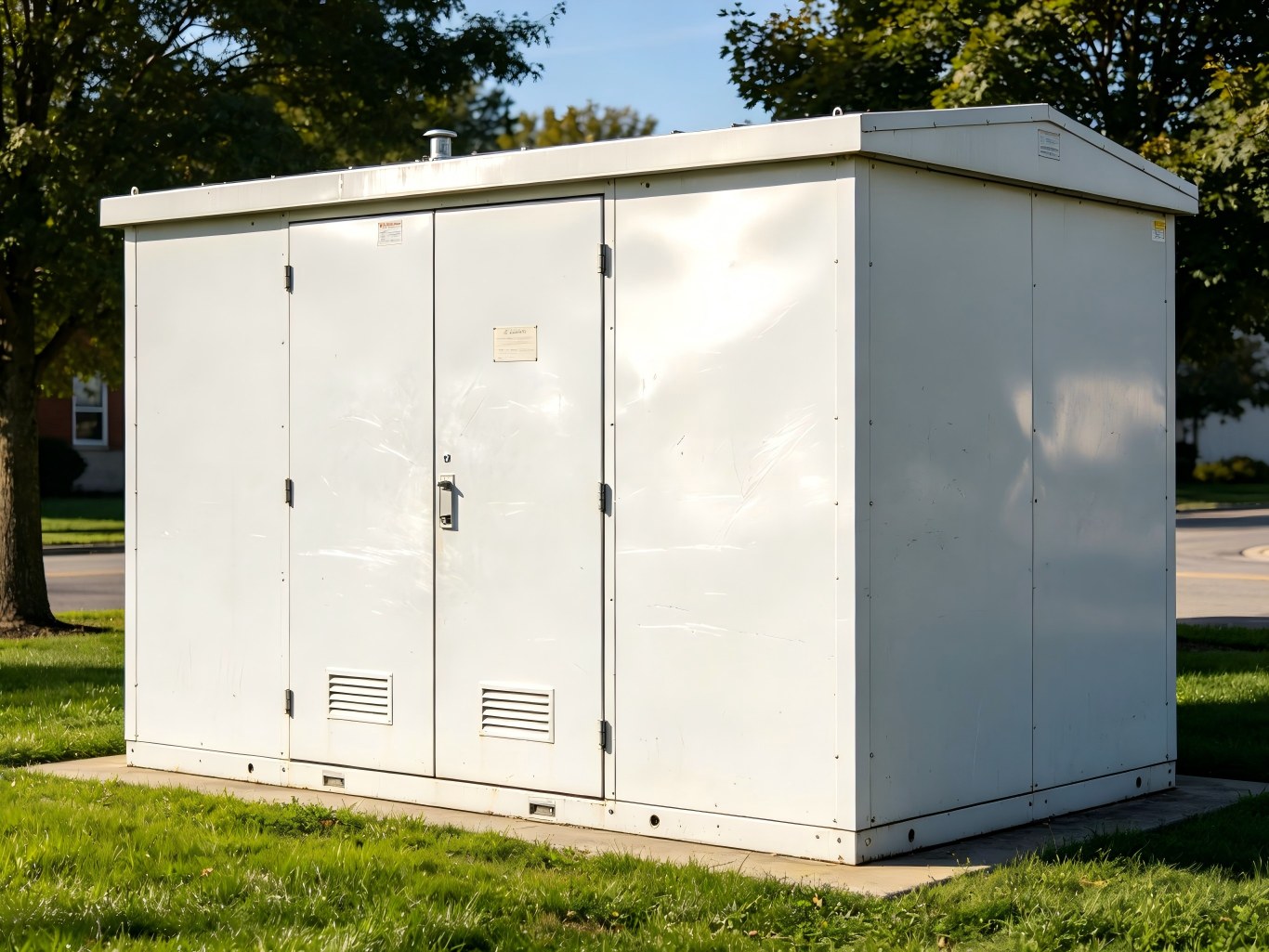

As a core component of outdoor medium-to-low voltage power supply systems, the operational logic of a kiosk substation is not complex; in essence, it involves the “front-end control, voltage step-down, and rational distribution” of the electricity transmitted by the power grid.
1. Incoming Lines
The 10kV or 35kV medium-voltage power transmitted from the power grid is first routed via incoming cables into the substation’s medium-voltage (MV) compartment. The equipment housed within—such as ring main units and load switches—is primarily responsible for three key functions: First, securely receiving the electrical energy from the grid, ensuring robust connections to prevent issues such as poor contact; second, controlling the switching (on/off) of circuits based on on-site power demand, thereby facilitating the proper startup and shutdown of equipment; and third, responding to potential faults occurring at the front end—such as common issues like line overloads, short circuits, or ground faults—by providing primary-level protection to prevent these malfunctions from propagating to downstream stages.
2. Voltage Step-Down and Conversion
The conditioned electrical energy—having undergone screening and protection within the MV compartment—is then directed straight into the transformer compartment. Utilizing the fundamental principles of electromagnetic induction, the transformer precisely steps down the incoming 10kV or 35kV medium-voltage power to 400V or 380V low-voltage power, which is directly usable by the end user.
3. Power Distribution and Diversion
The stepped-down low-voltage power enters the substation’s low-voltage switchgear room to undergo final diversion and power distribution. Within this room, the distribution apparatus divides the single-source low-voltage supply into multiple output circuits, tailored to various usage scenarios and requirements. These circuits feed power to diverse endpoints—such as factory production machinery, HVAC and lighting systems in commercial buildings, public amenities within residential complexes, and various auxiliary loads.
4. Comprehensive Protection and Real-Time Monitoring
Throughout the entire process—from the incoming power lines to the low-voltage outputs—the substation’s protection and monitoring systems remain continuously active. The system collects real-time data on parameters such as voltage, current, equipment temperature, and load levels. Should any anomaly be detected—such as an overload, short circuit, or equipment overheating—the system immediately triggers an automatic trip to isolate the faulty circuit, thereby preventing the fault from escalating. Furthermore, the system supports remote monitoring capabilities, allowing personnel to track the substation’s operational status in real time without needing to be physically on-site. This enables the timely resolution of potential hazards and ensures the long-term stability and reliability of the system.
FAQs
1. How does a kiosk substation work in simple terms?
It receives medium-voltage power, steps it down, and distributes low-voltage power to end users. In Wondon systems, the whole process follows a clear chain: incoming control → voltage transformation → power distribution.
2. What happens when power first enters the substation?
10kV or 35kV power enters the MV compartment for switching and protection. Wondon integrates RMU and load switches here to ensure safe connection, control, and fault isolation at the grid interface.
3. How is high voltage converted into usable power?
The transformer reduces MV power to 400V or 380V through electromagnetic induction. Wondon configures this step to ensure stable voltage output for real industrial and commercial loads.
4. How is electricity distributed after voltage reduction?
LV switchgear divides power into multiple outgoing circuits for different loads. Wondon designs this section to support stable and organized power delivery across all end applications.
5. How does the system protect against faults?
It continuously monitors and automatically isolates faults like overloads or short circuits. Wondon integrates real-time protection and remote monitoring to keep the system safe and stable.