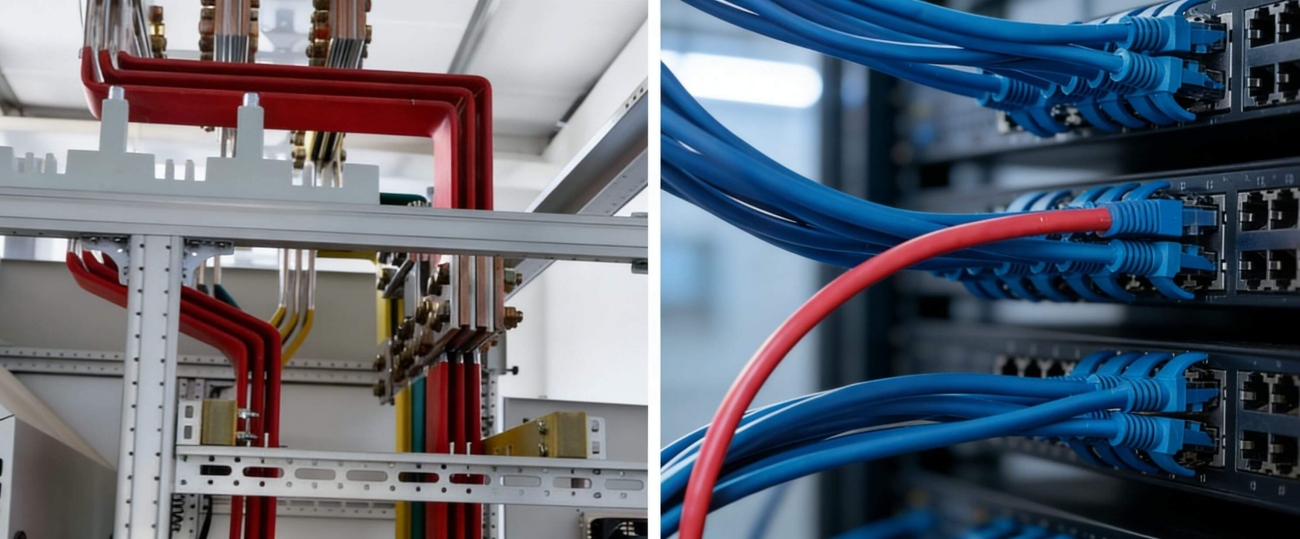

Busbar trunking and cable systems are widely used in power distribution, but differ in installation, capacity, flexibility, and space use.
1. Structural design
Busbar trunking has a metal enclosure with copper or aluminum bars inside, and is overall a rigid structure. It uses a modular design; sections can be connected one by one to form a complete power transmission path.
Cables use flexible insulated cables, usually laid in cable trays, conduits, or raceways. Each cable must be routed and fixed individually, which is relatively flexible.
2. Installation efficiency
Busbar trunking modules are prefabricated and assembled directly on site, with fast installation speed.
Cables need to be pulled, routed, fixed, and terminated one by one; every step is required.
3. Power transmission capacity
Busbar trunking has a metal enclosure that dissipates heat well and remains stable even when operating at full load. Suitable for places that require a large amount of power.
Cables can also carry large currents, but usually several cables need to be used together in parallel to handle them.
4. Flexibility and expandability
Busbar trunking makes it convenient to add electrical equipment later; just add tap-off units along the trunking position. Upgrading is simple, and the modification cost is low.
To add load with cables, you usually need to pull new cables or modify the circuit, and power may need to be cut off during this process.
5. Maintenance requirements
Busbar trunking has a fully enclosed structure, solid connections, is not easily affected by the environment, requires very little daily maintenance, and has high long‑term reliability.
Cables require regular inspection for insulation aging, cable displacement, and loose connections.