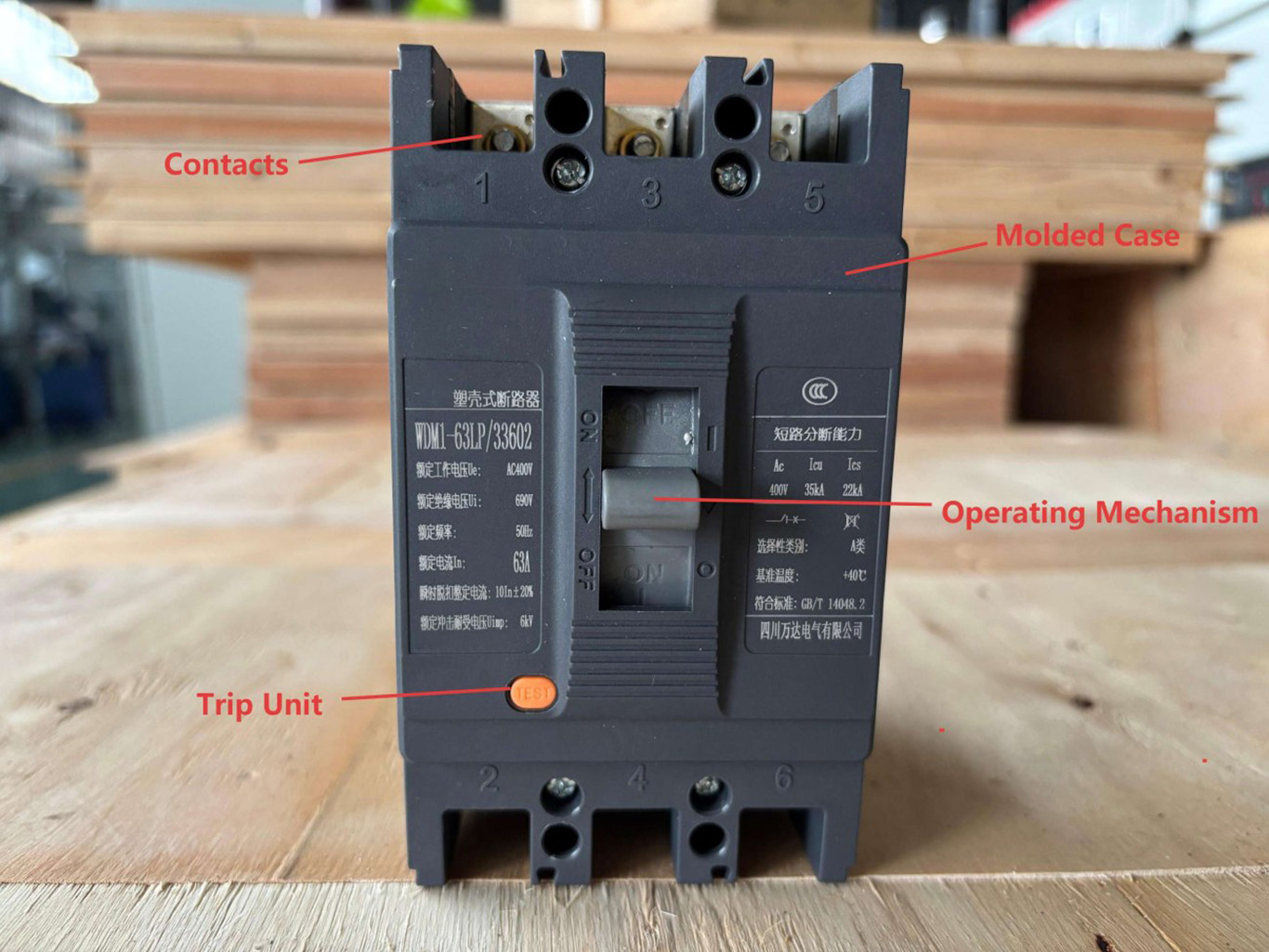

The MCCB is like a precisely designed machine, with each component performing its specific function and working together to build a safety barrier for the circuit. Understanding its basic components makes it easy to understand how it achieves precise protection.
1. Molded Case
Tightly encases all internal components, isolating them from external dust, moisture, and physical impact; it possesses excellent electrical insulation properties, effectively isolating high voltage and ensuring the safety of equipment and operators.
2. Contacts
Under normal operation, the contacts are tightly closed, ensuring smooth current flow to power the equipment; when a fault occurs, and power disconnection is required, the contacts quickly separate, instantly cutting off the current path.
3. Arc Chute
When the contacts separate, a strong electric arc is generated. The arc extinguishing chamber is specifically designed to suppress this arc. It can quickly capture and extinguish the arc, preventing the arc from burning the contacts or causing other dangers, ensuring a safe and thorough power disconnection process.
4. Trip Unit
Responsible for constantly monitoring the current status of the circuit. Once an overload, short circuit, or other abnormal condition is detected, it will immediately issue a command to trigger subsequent mechanisms, achieving power outage protection.
5. Operating Mechanism
It supports manual closing and opening of the circuit breaker, facilitating maintenance and testing; it also receives commands from the trip unit and automatically completes the tripping action, ensuring rapid and reliable power disconnection in the event of a fault. This mechanism is widely used in systems such as ATS control panels and power distribution panels, where operational reliability is essential.
FAQs
1. When I look at an MCCB, what are the key parts I should actually pay attention to in my project?
Focus on the molded case, contacts, arc chute, trip unit, and operating mechanism. Wondon helps you evaluate these core parts to match real project safety and performance needs.
2. Why does the molded case matter for my installation environment?
It provides insulation and protection from dust, moisture, and impact. Wondon ensures MCCBs are selected with suitable enclosure strength for your site conditions.
3. How do the contacts affect the stability of my electrical system?
They carry current during normal operation and disconnect during faults. Wondon selects MCCBs with a reliable contact design to ensure stable switching and safety.
4. What role does the arc chute play when a fault happens in my system?
It extinguishes the arc when contacts open, preventing damage or fire risk. Wondon focuses on strong arc suppression design for safer interruption performance.
5. If I’m designing a full distribution or ATS system, why does the operating mechanism matter?
It ensures reliable manual control and automatic tripping response. Wondon integrates MCCBs suitable for ATS panels and distribution systems requiring high operational reliability.