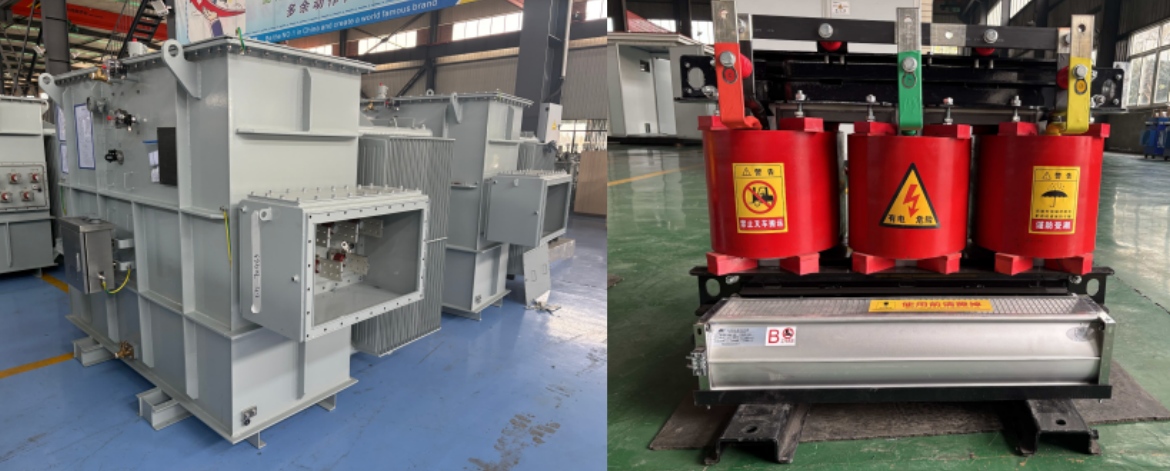

Whether to choose an oil-immersed distribution transformer or a dry-type distribution transformer depends mainly on the installation environment, safety, ease of maintenance, and application scenario. They are typically used in conjunction with other equipment in the power distribution system, such as low-voltage switchgear and distribution boxes, together forming a complete power supply solution. The following comparison points can help you determine which type is more suitable for your project.
1. Cooling Methods
Oil-immersed distribution transformers rely on insulating oil to dissipate heat and can withstand higher thermal loads, making them suitable for long‑term heavy load operation while remaining stable.
Dry-type distribution transformers rely on air or solid insulating materials to dissipate heat, using no liquid, so they are suitable for places where oil cooling is not appropriate.
2. Installation Environments
Oil-immersed distribution transformers are generally installed outdoors or in dedicated electrical rooms, requiring sufficient space and safety isolation.
Dry-type distribution transformers are often used indoors, such as in commercial buildings, hospitals, and public facilities, and are friendly to space and cleanliness requirements.
3. Safety Characteristics
Oil-immersed distribution transformers contain insulating oil inside, so certain fire prevention and protection measures are needed, and they are usually placed in controlled environments.
Dry-type distribution transformers have no oil, low fire risk, and low environmental impact, making them particularly suitable for places with strict safety requirements.
4. Maintenance Needs
Oil-immersed distribution transformers require regular inspection of the insulating oil condition and long‑term monitoring, so maintenance work is relatively more.
Dry-type distribution transformers require little to no concern about the cooling medium, with lower maintenance needs.
5. Applicable Scenarios
Oil-immersed distribution transformers are often used in outdoor or semi‑outdoor environments where space is sufficient, and safety isolation measures are complete.
Dry-type distribution transformers are more often used in commercial buildings, residential complexes, and indoor distribution systems, especially where safety, environmental protection, and space conditions are important.
FAQs
1. I’m not sure which one fits my project—oil-immersed or dry-type?
It mainly depends on your site conditions and safety requirements. Wondon reviews your project environment and helps you choose the right type.
2. What is the core difference I should really care about?
It comes down to the cooling method. Wondon helps you decide whether oil cooling or air cooling better fits your load and operating conditions.
3. How does the installation environment affect the choice?
Outdoor or large capacity projects often use oil-immersed, while indoor or space-sensitive sites usually prefer dry-type. Wondon evaluates this during system design.
4. Is safety the reason many projects choose dry-type transformers?
Yes, because there is no insulating oil, the fire risk is lower. Wondon often recommends dry-type for buildings with strict safety requirements.
5. If I still can’t decide, what can Wondon actually help me with?
Wondon works with your project data and system layout to recommend a complete transformer solution, not just a single product type.