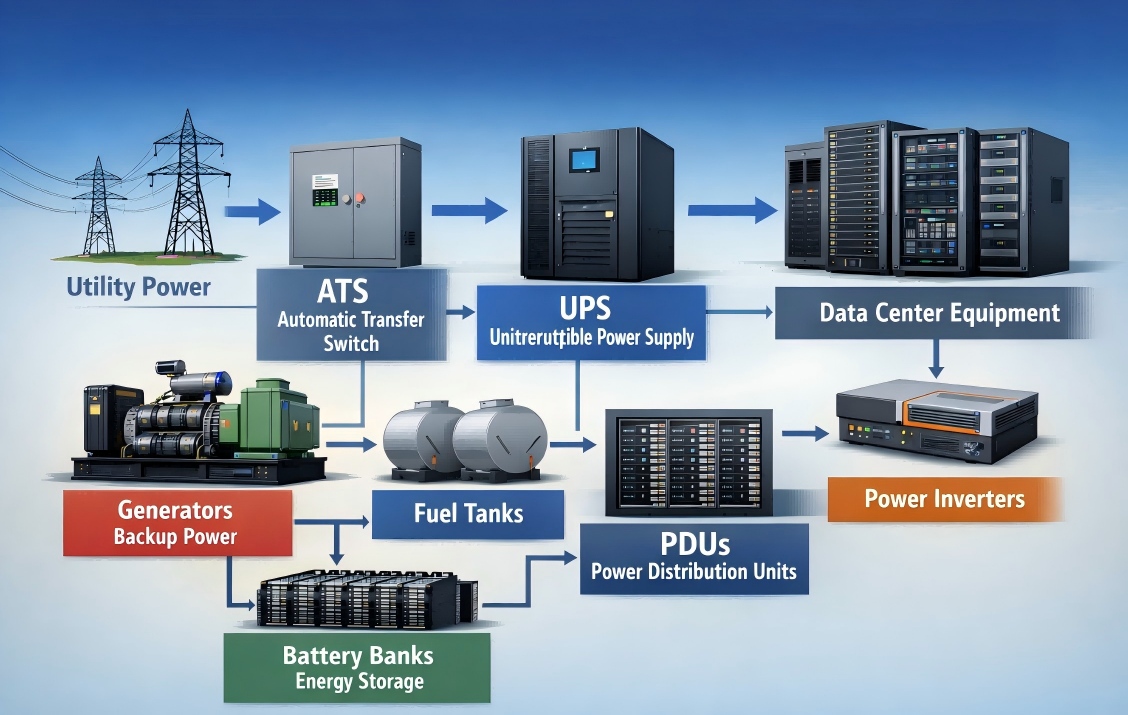

The power distribution system of a data center plays a critical role in ensuring operational stability, efficiency, and uptime. A well-designed system minimizes risks, supports future scalability, and guarantees continuous power supply for mission-critical operations. Proper planning before project implementation is essential.
1. Data Center Power Distribution System Architecture
A typical electrical distribution structure includes:
Mains Power → UPS → Power Distribution System → IT Load
High reliability must be ensured at each power distribution stage.
2. Redundancy Design: N+1 vs 2N
Redundancy is key to ensuring uninterrupted operation:
- N+1 Redundancy: Adds one backup component to support the system in case of failure.
- 2N Redundancy: Provides a fully duplicated system for maximum reliability.
Choosing between N+1 and 2N depends on the criticality of your data center and budget considerations. For high-availability environments, 2N is often preferred.
3. Data Center Power Distribution System Key Equipment
●Low voltage switchgear: Stable power distribution
●UPS: Backup power
●ATS: Automatic transfer switch
●Busbar trunking: Efficient power transmission
4. Common Design Mistakes
●Single point of failure
●Underestimating load growth
●Poor system integration
Why Choose Wondon?
Wondon provides customized power solutions that meet the high reliability requirements of data centers. Feel free to contact us anytime, we will help you build an efficient and reliable power distribution system for your data center.
FAQs
1. What is a data center power distribution system?
A data center power distribution system delivers stable and continuous electricity from the utility source to IT equipment. It typically includes UPS systems, switchgear, ATS, and busbar distribution to ensure reliable operation.
2. What is the difference between N+1 and 2N redundancy?
N+1 redundancy adds one backup component to support the system during failure, while 2N redundancy uses two completely independent power systems for maximum reliability. Wondon helps customers choose the right redundancy design based on uptime requirements and budget.
3. Why is UPS important in a data center?
A UPS (Uninterruptible Power Supply) provides backup power during outages and protects sensitive IT equipment from voltage fluctuations and power interruptions. It is a critical part of any reliable data center infrastructure.
4. What are common mistakes in data center power distribution design?
Common mistakes include creating single points of failure, underestimating future load growth, and poor integration between electrical systems. Proper planning helps improve reliability and scalability.
5. How can I improve the reliability of a data center power system?
Using redundant switchgear, dual power supplies, ATS systems, and efficient busbar distribution can significantly improve system reliability. Wondon provides customized power distribution solutions designed for high-availability data center applications.